The Dance of Possibility: Accessibility as Freedom
The Dance of Possibility: Accessibility as Freedom
By Brian Golden
Brian Golden is a dancer and choreographer based in Los Angeles and New York City. He is currently working in the capacity of a Dance Church 2025 Summer Research Intern.
In many dance and fitness classes, participants are expected to memorize, perform, and sometimes even reverse detailed choreography, leaving little room to process, adapt, or even enjoy the pure sensation of dance. For some, including myself, this can make the experience feel inaccessible before we’ve even started.
In Dance Church, the movement language is intentionally simple: punching the air, circling the hips, rolling the spine. These are actions with a clear A-to-B pathway, repeated enough times for the body to truly catch on. This simplicity is not about dumbing down the material, but about opening a door—a way to practice coordination without the panic of getting lost.
The repetitive and simple structure of a Dance Church class allows me to slow down when needed, choose my tempo, and avoid movements that might cause pain. True accessibility is about having the freedom to choose, and in Dance Church, that choice is built into the DNA of the class.
Being neurodivergent means I often move a few seconds behind the room—but in Dance Church, that lag isn’t a problem. It becomes a tool. I get to feel, respond, and build connections on my own timeline.
Accessibility in Dance Church is not just philosophical; it’s something you can feel in your body the moment you step into the room. It taps into the science of how humans move together—how repetition, choice, and shared rhythm don’t just make movement easier, but also forge connections. And that connection is more than social; it’s neurological. It’s what scientists call kinesthetic empathy.
What Is Kinesthetic Empathy?
You’re walking down the street and someone on a skateboard trips, flies forward, and slams into the pavement. You don’t know them. You weren’t the one who fell. But your whole body reacts—your stomach drops, your shoulders tense, you might even look away.
That’s kinesthetic empathy. It’s the body’s instinct to feel someone else’s movement as if it were your own. It’s not a choice—it’s neurological. Your brain sees someone move, and your own motor system lights up in response. Mirror neurons activate. Your nervous system takes in what just happened and echoes it, emotionally and physically.
In Dance Church, this kind of empathy is happening constantly. Not through pain, but through rhythm, imagination, effort, joy.
The DC team has worked with Spinal Cord Injury patients in Seattle, where even imagining movement, like feeling your feet sink into warm sand, can trigger brain-to-body signals, spark joy, and keep neural pathways active, even without physical execution. Multiple teachers demonstrate different options simultaneously—standing, seated, or in slow motion—so each person can choose what works for them without feeling “off” from the rest of the group.
Language matters, too. Just as in accessible rehearsal spaces I lead, the cues in Dance Church avoid ableist defaults like “run” or “take two steps back,” replacing them with open invitations such as “travel,” “glide,” or “journey.” These subtle shifts expand creative possibilities and remove unspoken hierarchies between “able” and “less able” bodies.
Whether you identify as “able,” “less able,” a “dancer” or “not a dancer,” we all benefit from this kind of accessibility and adaptability.
Scientists have found that dance activates more regions of the brain than almost any other activity. Movement, memory, emotion, rhythm, even imagination—they all light up. When you dance freely, you’re building cognitive flexibility—your brain’s ability to adapt in real time. When you repeat a sequence over and over, you’re strengthening neural pathways. And when you sync with others, your brain releases oxytocin, the hormone tied to trust and social bonding.
In this way, kinesthetic empathy becomes a shared resource in every class, bridging gaps between “able” and “less able,” “dancer” and “non-dancer.” When we move together, the body’s natural mirroring systems invite each of us into a deeper connection, regardless of background or ability. The benefits extend beyond the physical: neural pathways strengthen, emotional resonance builds, and a collective rhythm emerges. In Dance Church, this isn’t about perfect unison; it’s about expanding what participation can look like and recognizing that every mover contributes to the whole.
I have found that Dance Church offers a way and a place to investigate the possibility that there is power in embodied, real time choice making. It comes from not knowing what I’ll do next and trusting that the body will know before I do. It comes from moving alongside other people without pressure to match them.
Translation as Creative Freedom
What makes Dance Church unique is that it doesn’t force translation as an afterthought; it integrates accessibility into the structure from the start.
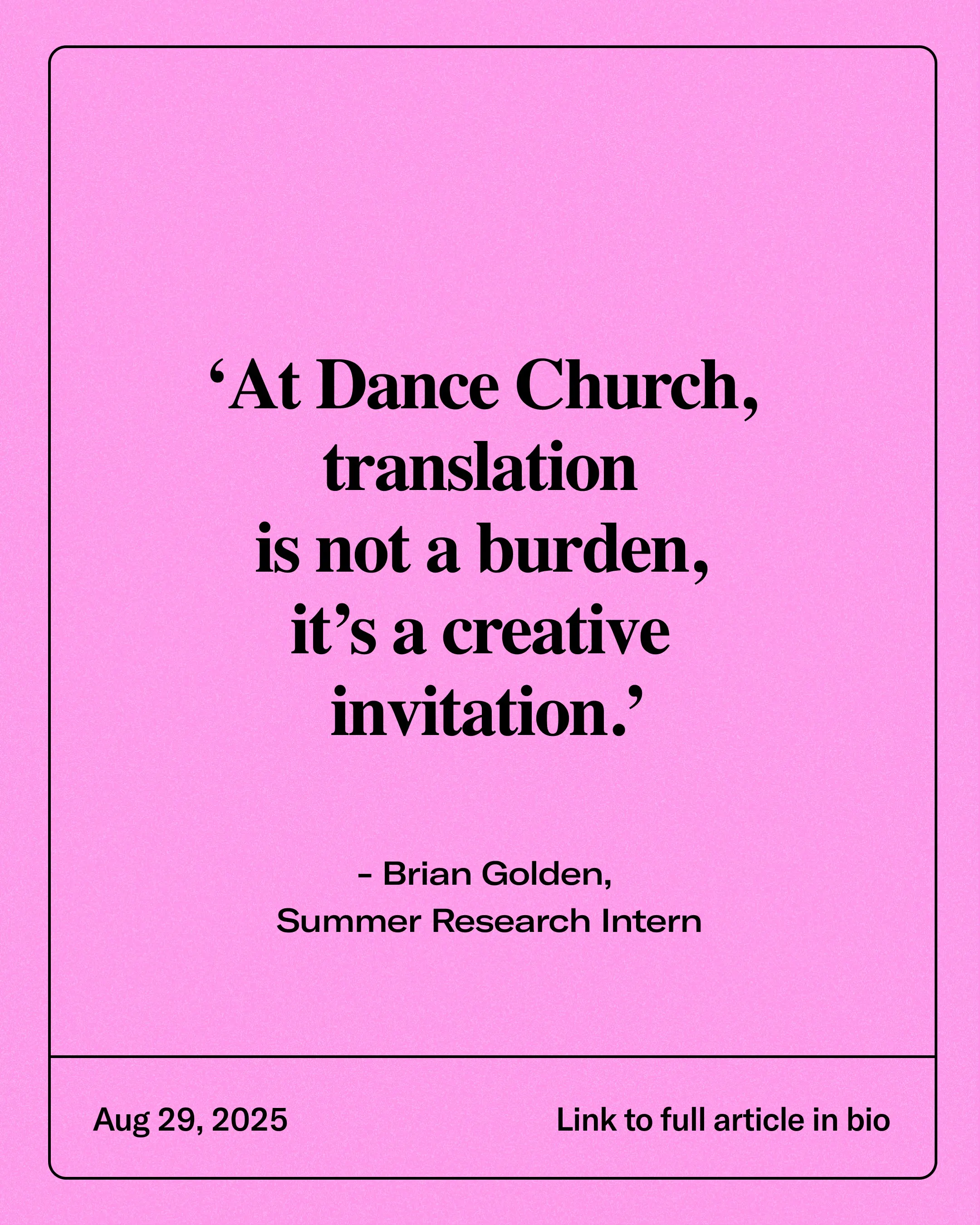
In many classes, if you can’t perform a movement as given, you’re left to quietly “translate” it while the rest of the room moves in sync. At Dance Church, translation is not a burden, it’s a creative invitation. It embodies something more expansive: the freedom to choose what kind of participation makes sense for you, today.
In Dance Church, accessibility lives in the unspoken invitation to modify, to pause, to go big, to stay internal, to close your eyes and breathe while the room keeps moving. It’s not about “opting out.” It’s about having options that meet you where you are.
Some days, access looks like slowing down a movement so your knee doesn't experience pain. Other days, it’s grabbing water and catching your breath.
If you can't dance through the room, perhaps you roll. If you can't squat low, maybe you stay standing tall, or bend your elbows like bending your knees. This mindset turns what could feel like exclusion into a shared game of possibility. Whether someone comes with an injury, chronic pain, fluctuating energy levels, or simply walks into Dance Church as the first dance class they’ve ever taken in their lives, they can still engage fully: sweating, connecting, and finding joy without being measured against a single standard of execution. In this way, Dance Church truly moves toward being a class for every body and every mind.
Brian Golden is a neurodivergent choreographer and movement director based between Los Angeles and New York. He is pursuing an MFA in Choreography at the California Institute of the Arts, with minors in Pedagogy and Integrated Media. A 2024 MAP Fund recipient, he will premiere a new immersive work in 2026. His choreography explores conflict, sensation, and identity through lived experience. His work has been presented at The Joyce Theater, Battery Dance Festival, and Jacob’s Pillow. He has choreographed commercially for artists like Yung Gravy and Daddy Yankee and was the 2024 Choreography Fellow with AXIS Dance Company.